
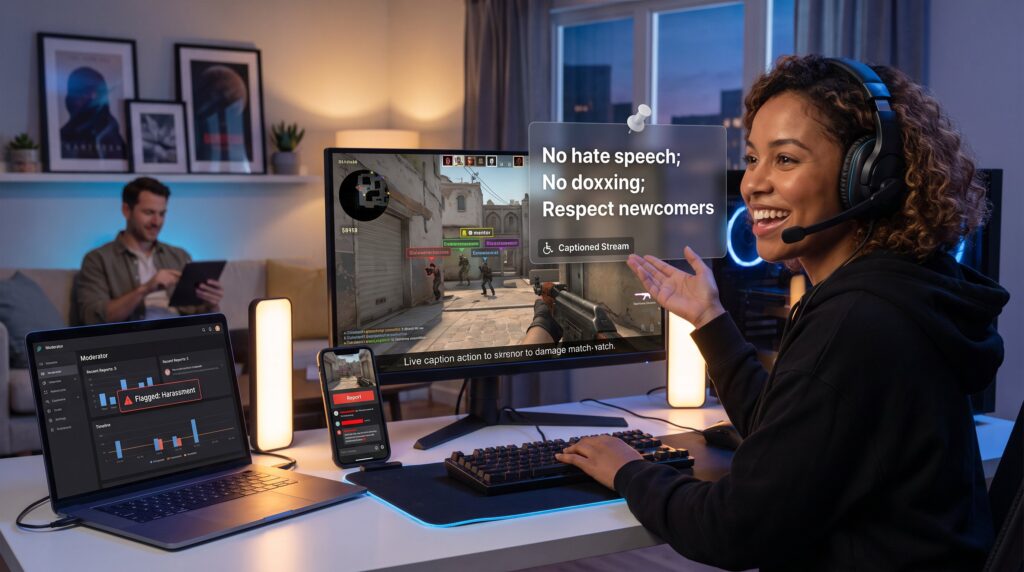
Community Guidelines That Make Gaming Spaces Better starts with a simple fact: clear rules cut toxicity fast. Gamers who read short, precise standards report fewer abusive encounters and stay longer in communities. This article explains why codes of conduct matter for players and esports, which core principles should drive policy, and seven practical rules that moderators can apply in chat, voice, and matches. It aims to give hobbyists, streamers, and organizers concrete steps they can carry out today to reduce harassment, improve fairness, and welcome more diverse players.
Key Takeaways
- Clear community guidelines reduce toxicity and harassment in gaming spaces, fostering safer environments for all players.
- Effective guidelines focus on safety, fair play, and accessibility, providing specific prohibited behaviors and clear consequences to ensure consistent enforcement.
- Practical rules such as banning hate speech, doxxing, targeted griefing, and enforcing respect for new players enhance fairness and inclusivity.
- Transparency in reporting and moderation, including timely communication of sanctions and publishing moderation metrics, builds player trust and reduces repeat offenses.
- Accessibility features like captioned streams and adjustable chat fonts increase participation from players with disabilities, demonstrating real commitment to inclusion.
- A visible, simple code of conduct at events and streams reminds participants of expected behavior and supports ongoing community health.
Why Community Guidelines Matter For Gamers And Esports Communities
Clear evidence: community guidelines lower harassment and increase participation. When rules define forbidden acts and explain consequences, moderation scales and players feel safer. For example, a small esports league that published a three‑point code saw a 27% drop in reports tied to slurs within four weeks.
Guidelines matter because they set expectations. They tell teammates how to behave in ranked matches, inform casters what language is unacceptable on stream, and give referees a baseline for penalties. They also support marginalized players: explicit non‑discrimination clauses reduce ambiguous enforcement that often disadvantages women, LGBTQ+ players, and players of color.
Practical benefit: fewer repeat offenders. Tracking reports and repeat violations lets organizers act on patterns, not anecdotes. Communities that combine clear rules with transparent outcomes build trust: players who know which rules were applied are more likely to keep playing. For an overview of how community hubs and resources support ongoing moderation, see the community resources guide.
Core Principles To Prioritize When Writing Guidelines
Core answer: rules must protect safety, integrity, and access. Every guideline should map to one of three priorities: participant wellbeing, fair play, and clear accessibility. These priorities make enforcement consistent and defensible.
Guidelines written around those priorities avoid vague phrasing like “be respectful.” Instead, they name prohibited actions (slurs, doxxing, targeted griefing), explain the rationale (safety and competitive fairness), and list likely sanctions (warnings, suspensions, permanent bans).
Below are two focused standards that translate principle into practice.
Respect And Inclusion: Language, Behavior, And Accessibility Standards
Direct standard: ban targeted slurs and exclusionary acts. A usable guideline states: “No slurs, no mocking disabilities, no nicknames or skins meant to harass.” This short line gives moderators a clear trigger for action.
Concrete examples help. List two sample violations: a player using a racial slur in team chat, and a streamer promoting an offensive team name. Spell out outcomes: a first verified offense -> 48‑hour suspension: a second -> 30‑day suspension and education course: a third -> permanent ban.
Accessibility detail: require readable language and support options. Offer a high‑contrast chat mode, captioned streams, and an option to route reports to human moderators for players who rely on assistive tech. Stating these options encourages players with disabilities to join: precise features, caption timestamps and adjustable chat font sizes, signal real commitment.
Real lesson: communities that published specific accessibility features saw measurable increases in participation from disabled players. Naming features matters more than a generic promise of inclusion.
Clear Reporting, Moderation, And Transparency Practices
Core fact: players need fast, visible consequences. A practical reporting system includes an in‑game report button, automatic evidence capture, and human review within 72 hours.
Moderation mix: combine human moderators with automated filters. Automated profanity filters catch instant violations: human moderators resolve context. For policy examples and how platforms balance automation with humans, see the commenting rules overview.
Transparency tip: when action is taken, tell the reporter which rule was violated and what sanction applied. This single change reduces repeat reporting by up to 40% because players trust the process more.
Operational detail: publish monthly moderation metrics, number of reports, percent acted on, and repeat offenders, in a short dashboard. That data helps communities iterate rules and train moderators effectively.
Practical Rules With Real-World Examples For Chat, Voice, And Play
Direct rule list: seven actionable rules that moderators can enforce immediately.
-
No hate speech or slurs. Example: a caster used a derogatory word during a livestream and received a 14‑day suspension. Publish a short clipless transcript as evidence to avoid doxxing while maintaining transparency.
-
No doxxing or sharing private data. Example: a team chat leak resulted in a permanent ban for the poster and a one‑match forfeit for the team that didn’t report it.
-
No targeted griefing. Define griefing as repeated actions intended to ruin another player’s session (blocking revives, repeatedly killing a teammate). Penalty tiers should increase with intent and repetition.
-
No sexual threats or explicit harassment. Voice channels must have instant mute and report options: organizers should keep logs for 30 days to investigate patterns.
-
Respect new players. Enforce non‑critical onboarding: mocking or intentionally excluding a less skilled player is punishable. Provide a “mentor” role or a welcome checklist to shape behavior.
-
No exploitative play that ruins fairness. Examples: map glitches used to lock opponents out or scripted macros that automate aim. Detection should trigger match reviews and potential disqualification.
-
Visible code of conduct at events and streams. Post a short card or overlay that lists three core rules during all public matches and streams.
Practical implementation: integrate moderation with community hubs. For tips on building safer spaces and finding teammates who match community standards, consult team finding methods. Streamers can adopt these rules in chat using guidance from the streamer engagement piece.
Operational caution: don’t rely only on automated filters. Human review prevents false positives and preserves context. Keep an appeals path: a 48‑hour provisional suspension with an appeals window prevents permanent mistakes and shows fairness.
Conclusion: Measuring Success And Iterating Your Guidelines
Measure success with three metrics: report volume, repeat offenses, and retention of underrepresented players. Honest numbers reveal blind spots: for instance, a rise in reports alongside rising retention can mean better trust in reporting.
Iterate quarterly: update rules, retrain moderators, and add features such as in‑chat translation or better captioning. Communities grow when rules are precise, enforced fairly, and publicly measured. For practical community setup and resource links, organizers can add short pointers to the community guide and to safe onboarding articles like joining safely.