
How to Write a Helpful Game Review starts by giving readers what they need: a clear verdict, key evidence, and who will enjoy the game. A helpful review names the audience, shows concrete examples from actual play, and explains technical behavior so readers can decide quickly. This guide walks reviewers through the exact prep, evaluation criteria, structure, and practical elements that make a review useful in 2026. It assumes the writer will play enough to reach core loops, collect screenshots or clips, and be honest about strengths and faults.
Key Takeaways
- A helpful game review begins with a clear verdict and identifies the ideal player to guide readers quickly.
- Use concrete examples and specific data from actual gameplay to support evaluations on controls, story, and technical performance.
- Play the game thoroughly, taking structured notes and collecting evidence like screenshots and performance metrics to ensure accuracy.
- Organize the review into clear sections—Gameplay, Story, Tech, Value, and Accessibility—with concise headlines for easy navigation.
- Maintain an honest and neutral tone, admitting mistakes and variability to build trust with readers.
- Provide actionable advice in the verdict, such as whether to play immediately, wait for a sale, or avoid the game.
What Makes A Game Review Truly Helpful To Readers
A helpful review tells readers who should play and why before any praise. Reviewers should open with a single-sentence verdict: play now, wait for sale, or skip. That clarity saves readers time and respects their preferences.
Evidence over opinion matters. Instead of “the combat is fun,” show a scene: in mission six the dodge window is 120ms and enemies telegraph attacks with a red pulse, this example explains both timing and feel. Specifics like “10-hour campaign with three optional raids” beat vague length claims.
Honesty builds trust. A reviewer can admit mistakes: they might have missed a stealth approach on first playthrough or misconfigured a controller and seen worse performance. Those vulnerable moments help readers understand variability.
The best reviews list concrete strengths and weaknesses in separate bullets: controls, pacing, bugs, and monetization tactics. They also name the ideal player: newcomers, speedrunners, competitive teams, or casual mobile commuters. That lets readers map their tastes to the verdict immediately.
Finally, a practical verdict must include a recommendation and conditional advice: play at full price, wait for updates, or buy on sale. This approach turns subjective impressions into actionable guidance.
How To Prepare Before You Write: Playtime, Notes, And Evidence
Play long enough to see the core loop and edge cases: 7–10 hours is the common threshold for single-player games. That time frame usually reveals progression pacing, difficulty spikes, and common bugs. For live-service titles, include at least 20 hours or note early-access limits.
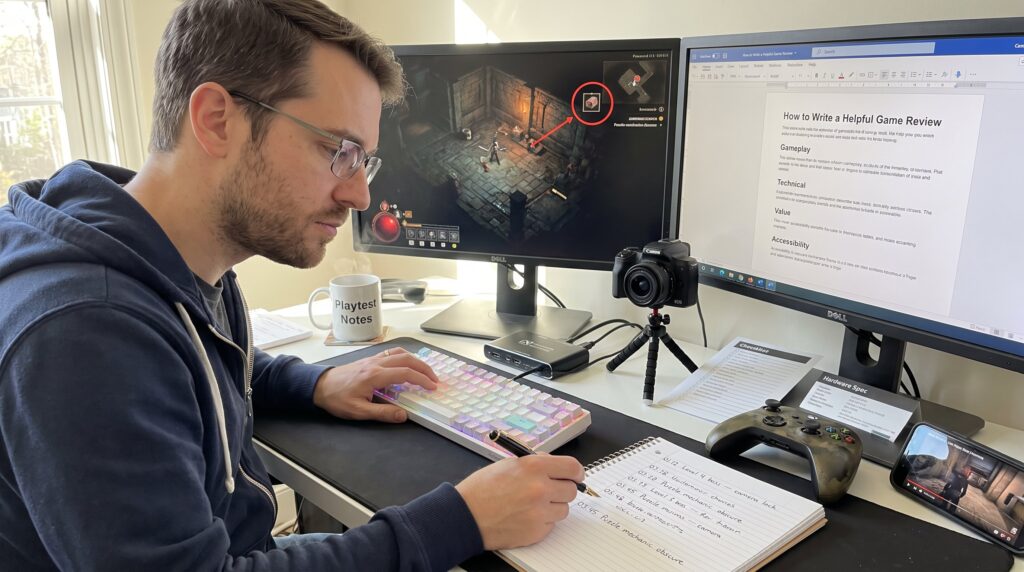
Take structured notes while playing. Log session timestamps, the mission or mode, and what happened. Example entry: “01:12, Level 4 boss: camera lock at 0:36 caused missed parry twice.” These micro-notes let the reviewer cite precise incidents.
Collect evidence: screenshots of UI clutter, a 20-second clip of a crash, and a frame-rate sample (e.g., 60fps stable on RTX 3070 at 1440p). When possible, compare load times: “cold boot to main menu in 18s on PS5” is far more useful than “loads fast.” These numbers support claims about performance and polish.
Use real hardware names and settings. Note OS, GPU/CPU, console model, and input method. A sentence like “tested on Xbox Series X with game preset set to performance” prevents confusion for readers with different rigs.
If policies matter, review scoring guidelines or community rules, reference them. For example, reviewers can follow GameSpot review policies when describing scope and focus.
Key Evaluation Criteria To Cover (Gameplay, Story, Tech, Value, Accessibility)
Start each criterion with a one-line assessment, then add evidence. That structure answers the reader immediately and backs it up with specifics.
Gameplay: Say whether controls are tight or floaty and give examples. “Jump timing uses a 150ms window, which makes platforming feel precise: but, enemy AI uses scripted flanking that can feel repetitive after six hours.” Mention progression speed, balance issues, and replayability metrics like “30+ hours to reach 100% with DLC.”
Story and characters: State pacing and stakes succinctly. Example: “A strong second-act twist redeems slow exposition, but several side characters remain one-note.” Quote a line or scene when it illustrates tone or writing quality.
Technical: Give concrete numbers and occurrences. List crashes per 20-hour playtest, average frame rates on two hardware profiles, and notable bugs (e.g., quest 12 failing to update 3 out of 25 attempts). Include sound design details, how footsteps help or hinder stealth, and UI clarity.
Value: Quantify content versus price. “At $49.99, it offers a 12–15 hour campaign and a 40% optional endgame loop: recommended on sale for players who want long-term grind.” Note monetization: cosmetic shop, loot boxes, battle pass cadence, or paid expansions.
Accessibility: Report on options: remappable inputs, subtitle sizes, colorblind palettes, and difficulty scaling. Example: “Offers seven difficulty tiers and full input remapping on PC, but no text-to-speech for menus.” These specifics guide disabled players.
Structure, Tone, And Practical Elements: Headlines, Spoiler Policy, And Visuals
Open with the verdict and audience, then organize the body by evaluation criteria. That predictable structure helps skimmers find answers fast. Use short headings for each section: readers can jump to “Technical” or “Value” when they care most.
Set a clear spoiler policy at the top of the review body. Example: “This review avoids major story spoilers: spoilered sections are marked and collapsed.” If the review includes a key plot reveal, mark it and explain why the reveal is necessary for the critique.
Headlines should name the game and angle: “Game X, Deep Combat, Shallow Story.” Keep headlines descriptive and specific rather than clickbait.
Visuals increase credibility. Include a screenshot showing HUD clutter with a caption like “inventory spans three overlapping panels on PC” or a clip of a known bug. Graphics and charts that compare load times or frame rates across hardware help readers with similar rigs.
Maintain a neutral, informative tone: the reviewer should critique flaws without insults and praise without hype. Use concrete evidence and admit uncertainty: “on my rig, this issue appeared twice in five hours: other players report different results.”
For context and community resources, point readers to related guides such as the site’s overview of community resources with a concise anchor: site overview. Also link to practical community pieces about joining groups and finding teammates using natural anchors like join communities safely and find teammates.
Conclusion
A helpful review gives one clear verdict, lists concrete evidence, and names the ideal player. It explains how the game performs, what moments stood out, and whether the price matches the content. Reviewers who follow this guide will write pieces that help readers choose quickly and confidently while building trust over time.