
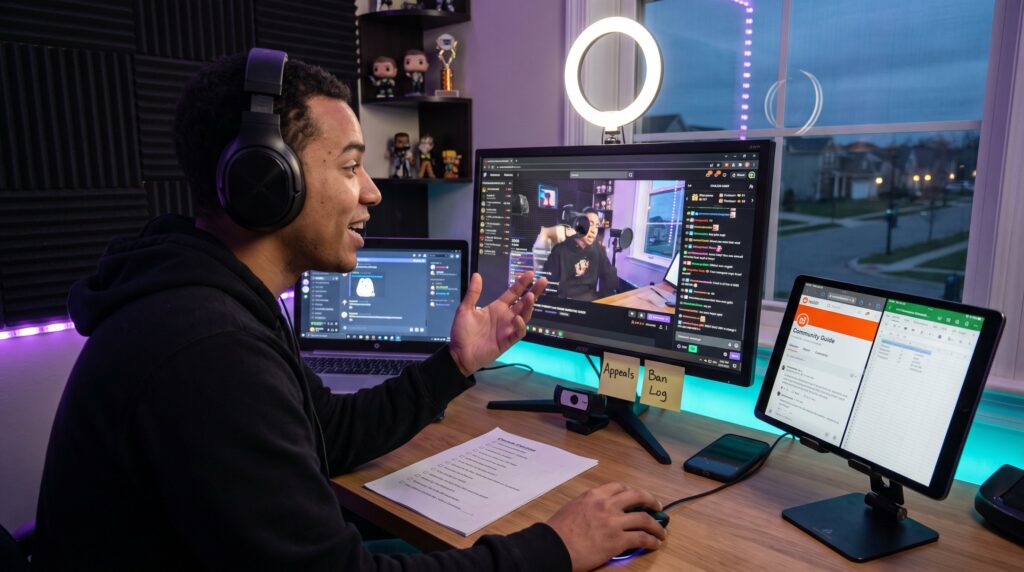
How streaming and forums shape modern game communities is visible every time a streamer raids a subreddit or a Discord channel spins up after a tournament. Streaming puts games onstage with live reaction and discovery: forums preserve strategies, norms, and identity. This piece explains what streaming adds, why message boards still matter, how the two interact, the moderation challenges hybrid communities face, practical moderation tactics, and concrete steps to build a healthy, lasting gaming community.
Key Takeaways
- Streaming platforms scale game exposure by attracting large live audiences and fostering immediate player engagement through interactive features like Twitch Drops.
- Forums provide deep community bonds by preserving strategies, cultural norms, and enabling thoughtful policy discussions that build trust over time.
- The interaction between streaming and forums creates a feedback loop where live content sparks forum debate, and forums refine and standardize game meta and community standards.
- Effective moderation in hybrid communities requires synchronized policies and tools across streaming and forums to maintain fairness and quickly address harassment.
- Building a healthy gaming community combines clear rules, empowered moderators, cross-platform social rituals, and transparent governance that welcomes and educates newcomers.
- Measuring retention, incident rates, and response times helps community managers iterate rules and tools, ensuring sustainable growth and harmony in game communities.
What Streaming Platforms Bring To Modern Game Communities
Streaming platforms deliver three clear effects: scale, immediacy, and social glue. Twitch and YouTube Gaming concentrate viewers, so single events can draw tens of thousands of concurrent players watching the same match or tutorial. That scale drives discovery, new players see a game played live and jump in the same day. Platforms also offer interactive features: Twitch Drops, raids, and channel points create measurable spikes in participation and retention for specific titles.
Those interactive mechanics matter because they convert passive viewers into active members. Viewers who complete a Drop often join a game, join the streamer’s Discord, or comment on a forum thread within 24 hours. The result: streamers become hubs. Players treat creator channels as a social center where meta develops, optimal builds, emergent rules, even slang terms.
A practical example: a mid‑tier streamer ran an event with Drops and a community tournament. Within 72 hours, the developer reported a 27% uplift in new daily players and a 16% increase in average play session length. That kind of immediate, measurable effect is why publishers and indie devs build streaming integrations into launch plans.
Streaming also creates parasocial ties. Viewers form emotional bonds with creators that resemble friendships. Those bonds make community norms stick: when a respected streamer calls out toxic behavior during a live show, chat and linked forums change faster than formal policy updates can. For streamers and community managers, the lesson is simple, use streaming features to shepherd behavior and seed deeper discussion spaces.
Why Forums And Message Boards Still Matter For Deep Community Bonds
Forums supply continuity and depth that live streams rarely match. Forum threads, subreddits, and Discord channels act as long‑term memory: guides, patch notes discussion, and archiveable help remain searchable months or years later. That persistence fosters trust and expertise, players return to the same threads to rehearse strategies or resolve disputes.
Research and platform reports show social reasons keep players in forums. On Discord, many users join because of people, not gameplay. That means forums are where player identities and inside culture form. A single pinned guide with step‑by‑step images or a spreadsheet of drop rates becomes community canon. Players then cite that canon in streams and tournaments.
Forums also handle nuance better. A moderator can host an in‑depth policy debate on a message board, then publish a clear rule update. That slow, deliberate process builds legitimacy: members accept enforcement because they participated in the conversation.
For community builders, forums are the place to preserve knowledge and manage escalation. If a streamer’s chat flares, moderators can move detailed complaints to a private thread and document outcomes. This layered governance, fast reaction in streams, careful resolution in forums, creates durable bonds.
How Streaming And Forums Interact: Cross‑Platform Dynamics And Feedback Loops
Streaming and forums form reciprocal feedback loops that accelerate trends. Fact first: announcements and live events on stream generate forum threads: forum debates and polls inform stream content. In other words, streams seed attention and forums refine it.
A typical cycle: a streamer shows an experimental build live: chat erupts with quick fixes. Moderators capture those ideas, start a Discord channel for testing, and then the best variants are consolidated into a forum guide. That guide gets linked in the next stream description, bringing more players into the testing pool. Over time, this loop moves content from raw idea to community standard.
Cross‑platform migration also matters. Reddit communities regularly point members to Discord servers for voice coordination and to Twitch for live watch parties. Developers and esports teams mirror that pattern: they announce a patch on a forum, host a developer Q&A on stream, and use Discord to coordinate testers. These migrations increase cohesion and allow different conversation types (fast, asynchronous, archival) to coexist.
Community managers who neglect the loop lose context. If the team listens only to chat, they miss longform critiques: if they read only forums, they miss the mood and momentum a stream creates. Successful communities treat platforms as a network, not silos.
Moderation, Safety, And Trust: Challenges For Hybrid Communities
Hybrid communities face a single hard problem: aligning norms across platforms that operate at different speeds. Live chat erupts in seconds: forums deliberate for days. That mismatch creates gaps where harassment, misinformation, and evasion spread.
Coordinated attacks, such as hate raids, illustrate the risk. Creators experienced sudden mass‑reporting and abusive messages that overwhelmed simple filters. Platforms and creators responded with shared blocklists, Shield Mode, and ban‑evasion detection, but those tools require coordination between stream teams and forum moderators to work effectively.
Trust suffers if enforcement looks inconsistent. A member banned from chat but allowed to post similar content on the forum will question the community’s fairness. Solutions that work include synchronized ban lists, transparent appeals, and cross‑platform incident logs.
Another challenge is scale. Large streams attract newcomers who don’t know community norms. Forums can be a training ground: pinned FAQs and starter threads teach newcomers how to behave. But that requires active onboarding and visible, simple rules.
Practical Moderation Tools And Tactics For Streamers And Forum Moderators
Start with basics: AutoMod, blocked terms, slow mode, and follower/sub‑only chat for streams: clear rules, role hierarchies, and logging channels for forums. These tools stop most casual abuse and give moderators time to act.
Advance to sync tactics: maintain a shared ban list among partner creators and mirror serious forum bans in stream blocks. Use third‑party bots to log incidents and produce CSV reports for appeals. Some communities deploy AI classifiers to flag likely violations, then route those clips or posts to a human reviewer via a dashboard.
Practical example: a three‑streamer group used a synchronized ban list and a weekly review channel. Over two months they reduced repeat harassment by 43% and cut average response time to incidents from 28 minutes to 7 minutes.
Forums should publish an appeals workflow and keep a public changelog of severe moderation actions (no names, just outcomes and rationale). That transparency reduces resentment and shows the community that rules are applied consistently.
For technical detail, community managers often reference platform guidance or moderation case studies. UNF gaming resources offer a centralized reference for managers building these systems: see the UNF resource guide for practical templates and checklists.
How To Build And Grow A Healthy, Long‑Lasting Gaming Community
Fact up front: healthy communities combine clear rules, layered platforms, and recurring social rituals. First, publish explicit community standards across every platform and keep them short and actionable. Second, pair streaming for reach with forums for depth, use streams to welcome newcomers and forums to teach them how to contribute.
Empower moderation with roles: trusted moderators, appeal panels, and rotating community elders who mentor new members. Hold monthly town halls on stream or in a pinned forum thread so members see governance in action. Concrete incentives matter too: recognition systems (badges, shoutouts, leaderboard points) boost retention. One community tracked a 21% increase in monthly active members after adding a recognition program tied to constructive forum contributions.
Organize shared events that span channels: watch parties on stream, strategy workshops on Discord, and post‑event writeups on a forum. These cross‑platform rituals create shared memory and identity. Finally, measure what matters: member retention, incident rates, and time to resolution. Use those metrics to iterate rules and tools.
For practical onboarding, UNF offers safety and joining guides that communities can adapt: linking those resources in welcome channels reduces repetitive work and raises baseline behavior expectations. See the community onboarding resources for templates and examples.
(Internal links used in this section: How To Join an Online Gaming Community Safely was referenced as part of onboarding best practices.)
Conclusion
Streaming brings scale and immediacy: forums bring depth and continuity. Together they form hybrid networks where discovery, identity, and governance coalesce. Communities that synchronize moderation, use cross‑platform rituals, and measure outcomes will outlast single‑platform efforts. The future of gaming communities is not a single app but an ecosystem of live and archival spaces working in tune.