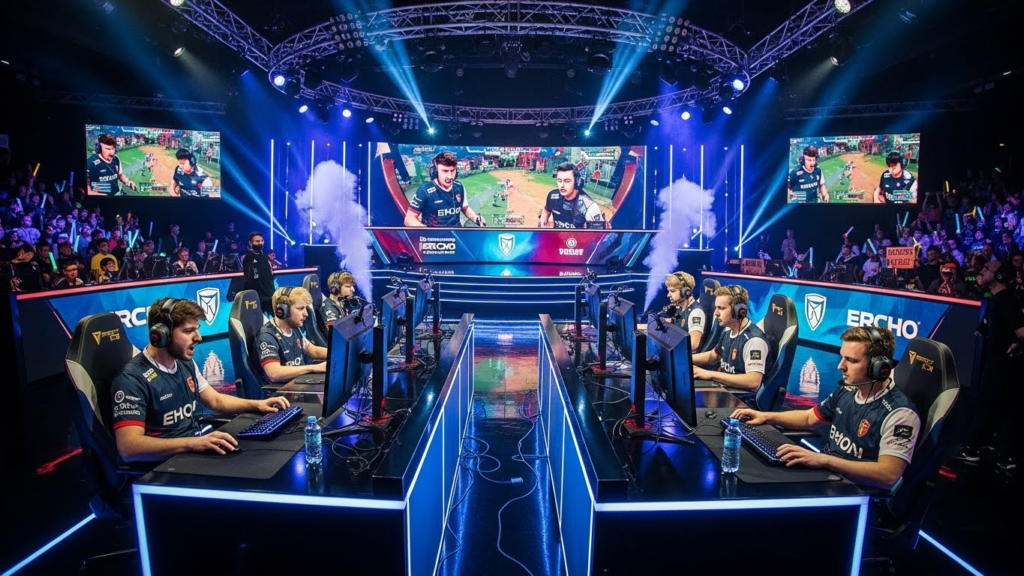
Competitive games are not difficult to follow because they are digital. They are difficult to follow because each title asks players to solve a different type of problem. A tactical shooter rewards timing and map control, a MOBA rewards long-form strategy, a car football game rewards mechanics under pressure, and a football simulation rewards reading space like a real match.
For Canadian readers, Ontario is a useful example of how digital entertainment is often separated into distinct categories: esports, regulated betting, and casino-style gaming. A reader moving between esports coverage and betting-related content may also come across promotional offers connected with a 1xbet promo code. For some esports fans, these bonuses can add an extra layer of entertainment while following tournaments or supporting favourite teams, provided that betting stays responsible, controlled, and clearly secondary to the enjoyment of the competition itself.
That distinction matters because esports games are built around skill expression. The audience watches not only who wins, but how the game creates pressure, limits information, and forces decisions. Understanding the genre makes the match easier to read.
What makes an esports game competitive?
An esports title usually needs three layers. First, the rules must be understandable enough for spectators to follow. Second, the skill ceiling must be high enough that experienced players can keep improving. Third, the game must produce repeatable tension across many matches.
This is why four very different games can all work as esports. CS2, Dota 2, Rocket League, and EA Sports FC do not share the same rhythm, but each creates a clear contest between execution and decision-making.
|
Game |
Genre |
Core competitive question |
What spectators should watch |
|
CS2 |
Tactical first-person shooter |
Can a team control space and win key duels? |
Utility use, timing, positioning, economy |
|
Dota 2 |
MOBA |
Can a team convert hero choices into map control? |
Draft, lanes, objectives, team fights |
|
Rocket League |
Vehicle sports game |
Can players turn mechanics into pressure? |
Boost management, aerial control, rotations |
|
EA Sports FC |
Football simulation |
Can a player create and defend space? |
Passing angles, pressing, tempo, finishing |
The common thread is not the visual style. It is the way each game makes small decisions visible under competitive conditions.
CS2: tactical pressure in short rounds
CS2 belongs to the tactical shooter family. Its competitive appeal comes from limited information, sharp aim, and round-by-round decisions. Players must judge where opponents might be, when to use utility, and whether a risk is worth the potential reward.
The genre is easy to misunderstand. Aim matters, but it is only part of the contest. A team can lose even with strong mechanical players if it wastes grenades, moves without spacing, or gives away map control too early.
For new viewers, the most useful things to watch are:
- how teams take or deny areas of the map
- when they slow down after early contact
- how they use utility before entering a bombsite
- whether they preserve weapons when a round is unlikely to be won
CS2 works as an esport because each round is compact. Mistakes are visible, recovery is difficult, and the scoreboard reflects both individual duels and team discipline.
Dota 2: long-form strategy through heroes and objectives
Dota 2 is a multiplayer online battle arena, usually shortened to MOBA. The format places heavy weight on hero selection, lane matchups, item choices, and timing windows. A viewer who only follows kills will miss much of the real contest.
The central idea is territory. Teams fight for lanes, towers, vision, jungle resources, and major objectives. A fight can look successful in the moment but still be poor if it delays an important item timing or leaves the map open elsewhere.
Dota 2 also shows why esports can be strategic without resembling traditional sport. Each match becomes a layered problem. One team may want to force early fights, while the other may need time for stronger late-game heroes. The game is competitive because both plans can be valid, but only if executed with discipline.
For readers new to Dota 2, the draft is the first clue. It tells you whether a team wants tempo, scaling, team-fight control, or split pressure. Once that is clear, the match becomes easier to follow.
Rocket League: simple rules, extreme execution
Rocket League has one of the clearest premises in esports: cars, a ball, and goals. That simplicity is valuable. A new viewer can understand the objective within seconds, even if the advanced mechanics take much longer to read.
The competitive depth comes from physics and space. Players must manage boost, control aerial movement, rotate behind teammates, and decide when to challenge or retreat. The ball moves quickly, but the best teams do not chase every touch. They shape pressure through positioning.
This creates a useful viewing rule: do not only watch the player hitting the ball. Watch the second and third players. Their positioning often explains whether the team is attacking safely or leaving itself exposed to a counterattack.
Rocket League is competitive because execution is constant. There are few pauses, and small mechanical errors can turn into immediate goals. The result is a game that feels accessible on the surface but demanding at a high level.
EA Sports FC: football knowledge in a digital format
EA Sports FC sits closer to traditional sport than the other titles discussed here. Its competitive identity is built around football patterns: passing lanes, pressing triggers, defensive shape, and chance creation. The difference is that one player can control an entire team, so decision speed becomes central.
A strong EA Sports FC player reads the pitch before the obvious pass appears. They use short combinations to move defenders, change tempo to create space, and avoid forcing shots from low-value positions. On defence, patience often matters as much as aggression.
The title is also useful for readers who already understand football. Concepts such as width, overloads, transitions, and counter-pressing transfer naturally into the game. What changes is the input layer. The player must convert football decisions into precise controller actions under time pressure.
That mix explains its place in esports. It is not only a football simulation. It is a competitive test of pattern recognition, timing, and execution.
How to choose which esport to follow
The easiest way to pick an esport is to match the game type with the kind of competition you enjoy watching. There is no single correct entry point.
CS2 suits viewers who like short rounds, direct pressure, and tactical discipline. Dota 2 suits viewers who enjoy drafts, long strategy arcs, and team-fight complexity. Rocket League suits viewers who prefer fast movement, visible mechanics, and immediate momentum swings. EA Sports FC suits viewers who understand football and want to see tactical ideas compressed into one-on-one digital competition.
The practical advice is simple: learn the win condition first, then learn the resources. In CS2, watch weapons, utility, and space. In Dota 2, watch heroes, items, and objectives. In Rocket League, watch boost and rotations. In EA Sports FC, watch passing lanes and defensive shape.
Esports becomes clearer when genres are treated as systems, not just games. Once the system is visible, the match stops looking chaotic and starts looking like a sequence of decisions.