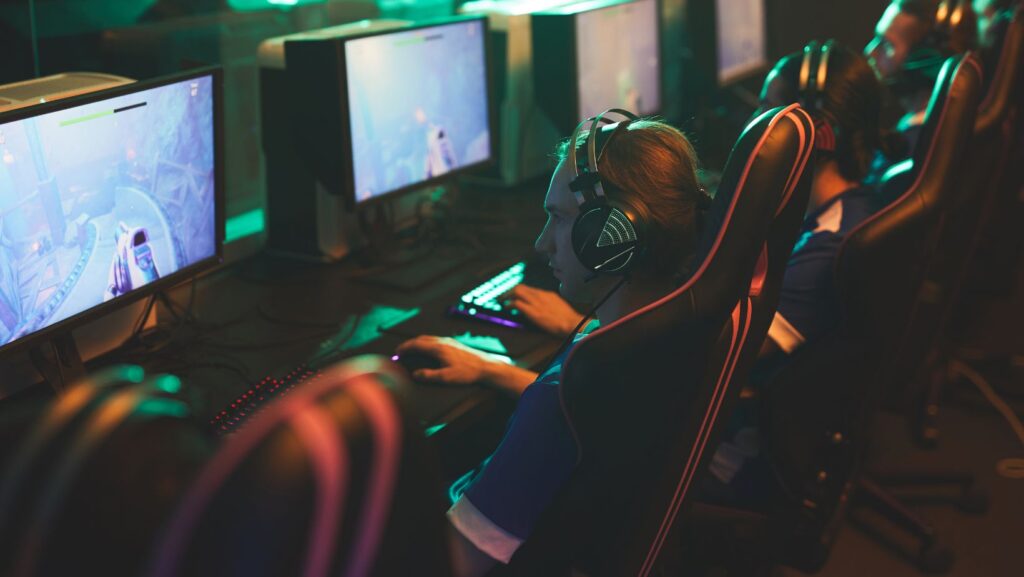
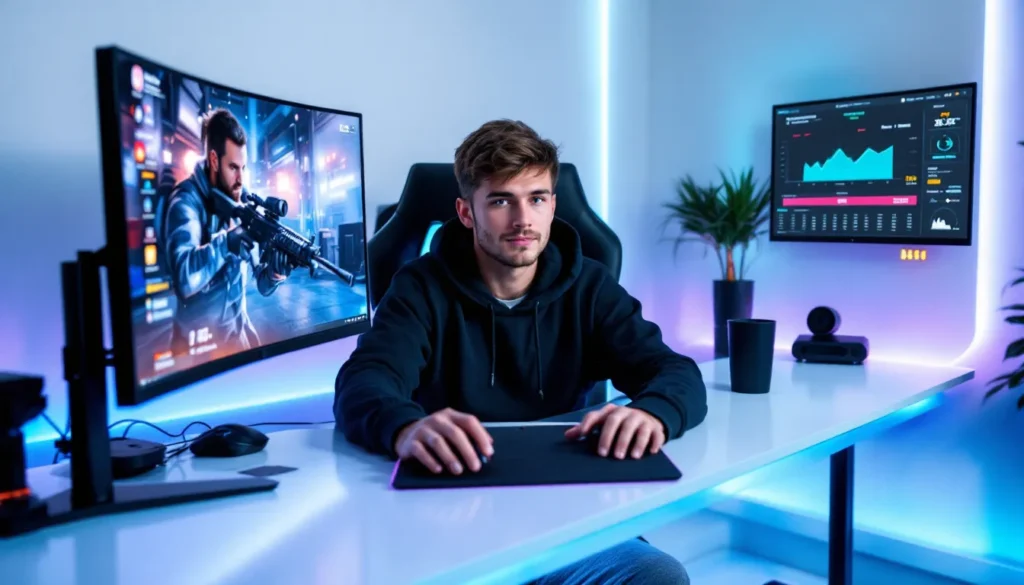
Reaction time separates the clutch players from the ones left in the dust. Whether you’re grinding ranked matches in valorant, competing in fighting game tournaments, or just trying to keep up with your squad in fast-paced shooters, milliseconds matter. A 50ms improvement might not sound like much until you’re the one landing the shot first or dodging the incoming attack. The good news? Reaction time isn’t some fixed genetic lottery. It’s trainable, measurable, and improvable through the right combination of hardware optimization, deliberate practice, and lifestyle changes. This guide breaks down exactly how to improve reaction time for gaming, pulling from neuroscience, esports coaching practices, and the routines that pro players actually use.
Key Takeaways
- Improving reaction time for gaming requires optimized hardware—240Hz monitors with 1ms response time, mechanical keyboards, and high polling rate mice—combined with deliberate practice to gain a competitive edge.
- Aim trainers like Aim Lab and Kovaak’s, along with game-specific drills, build muscle memory faster than ranked grinding alone; 30-60 minutes of focused daily practice outperforms unfocused play.
- Sleep deprivation reduces reaction time by 20-30%, so prioritize 7-9 hours nightly with consistent sleep schedules as non-negotiable for peak gaming performance.
- Physical conditioning through hand-eye coordination exercises, meditation, and regular cardio fitness improves neural processing speed and oxygen delivery to the brain.
- Track measurable progress through monthly reaction time tests, kill-death ratios, aim trainer scores, and clutch win rates to identify which training methods work best for your improvement.
Why Reaction Time Matters In Gaming
The Competitive Edge In Fast-Paced Games
In competitive shooters like CS:GO, Apex Legends, or Overwatch 2, reaction time directly impacts win rates. The average human reaction time sits around 200-300ms, but professional esports players operate in the 100-150ms range. That gap? It’s the difference between trading kills and getting caught flat-footed.
Consider a 1v1 scenario in a tactical shooter. Both players see each other simultaneously. The one with the faster reaction time rotates their aim and fires first, even if both had identical aim skill otherwise. Over hundreds of engagements, that consistency compounds into significantly higher kill-death ratios and match wins.
Fighting games like Street Fighter 6 or Tekken 8 are even more unforgiving. A player needs to react to mix-ups, block incoming strings, and execute combos within tiny windows. A 50ms disadvantage in reaction time can mean the difference between punishing an opponent’s unsafe move and eating a full combo.
Moba games like League of Legends demand faster reaction times during team fights. Spotting threats, kiting away from threats, and timing ability casts happens in milliseconds. Faster reflexes lead to more fights won and fewer deaths.
The Neuroscience Behind Gaming Reflexes
Reaction time involves three stages: stimulus detection, neural processing, and motor response. When an opponent appears on screen, your eyes detect the stimulus. Your brain processes that information and decides on an action. Finally, your fingers execute that decision, clicking the mouse, pressing a button, moving the keyboard.
Each stage has a biological floor, but each is also trainable. The eyes can be conditioned to detect threats faster. Neural pathways strengthen with repetition, making decision-making quicker. Motor memory develops so actions happen without conscious thought.
Dopamine and norepinephrine, neurotransmitters linked to focus and alertness, play key roles in reaction speed. That’s why players perform better when mentally engaged versus mentally fatigued. Sleep deprivation lowers these neurotransmitter levels, directly worsening reaction times.
Myelination is another factor. Repeated actions build thicker myelin sheaths around neural pathways, speeding up electrical impulses. This is why the same motion repeated 10,000 times feels automatic, the neural highway has been widened and smoothed. Competitive gamers leverage this by drilling the same scenarios hundreds of times, hardwiring optimal responses.
Essential Hardware Setup For Optimal Reaction Time
Monitor Refresh Rates And Response Times
Hardware matters more than many casual gamers realize. A 60Hz monitor displays 60 frames per second. At 144Hz, you get 144. The difference is that with higher refresh rates, you see the enemy sooner, sometimes by 6-8ms per frame. Competitive players use 240Hz or even 360Hz displays for this exact reason.
Response time (pixel switching speed) is equally critical. A monitor with 1ms response time shows your input on screen 1ms after you make it. A 5ms monitor delays that by 5ms. Over hundreds of interactions per match, those milliseconds stack up. Look for displays rated 1ms (gray-to-gray) or faster, this is now the standard for gaming monitors.
Gaming monitors reviewed at RTINGS provide detailed response time testing and input lag measurements if you’re comparing models. Most competitive titles benefit from at least 144Hz, 1ms response time as a baseline. 240Hz is the sweet spot for most FPS games, while fighting games can leverage even higher refresh rates.
Mouse And Keyboard Sensitivity Optimization
Sensitivity settings directly affect how quickly players can rotate their aim or move their character. This is personal preference territory, but there’s a science to finding your optimal range.
Most pros use between 400-800 DPI with in-game sensitivity multipliers that result in a 360-degree turn between 15-30 centimeters of mouse movement. This balance allows precise flick shots without requiring massive arm movements that slow you down.
Consistent sensitivity is more important than finding the “perfect” number. Muscle memory develops when the same input always produces the same output. Switching sensitivities kills that consistency. Many professionals lock in their sens and never change it, even across different games (with game-specific adjustments).
Keyboard response times matter too. Mechanical keyboards with fast actuation (0.1ms response time) beat membrane keyboards (10-20ms). If you’re typing a keystroke, you want that input registered immediately. Budget gaming keyboards now include this, so you don’t need to spend a fortune, just avoid cheap membrane boards.
Programs like ProSettings document the exact DPI, in-game sens, and hardware of professional players. Trying a pro player’s settings from your favorite game is a good starting point before you dial in your own preference.
Reducing Input Lag Across Platforms
Input lag is the invisible delay between your action and the game’s response. It compounds from multiple sources: USB polling rate, game engine latency, network latency, and monitor response time.
On PC, set your mouse polling rate to 1000Hz (if supported, that’s one report per millisecond). Most gaming mice offer this now. Disable V-sync unless you have screen tearing issues: V-sync can introduce 16-33ms of lag on 60Hz displays. Ensure your game runs at consistently high frame rates, frame time consistency matters as much as raw FPS.
On console (PS5, Xbox Series X), input lag is baked into the system, but you can minimize it by using a wired controller connection, disabling motion controls if you don’t use them, and playing on a low-latency monitor. The Ultimate Gaming PC Desk Guide covers peripheral positioning that reduces reach and latency.
Network latency (ping) is critical for online play. A 20ms ping is noticeably snappier than 80ms. Play on servers closest to you and ensure a stable connection, wired Ethernet beats WiFi for competitive gaming.
This matters even more if you or your squad run a private server rather than relying on public matchmaking — picking a dedicated game server by PingPlayers with a data center actually near your group locks in that low-ping baseline for everyone, instead of one player’s ping being fine while a teammate three regions away eats the delay. It’s the same principle as hardware optimization: shaving milliseconds off network latency compounds with faster reflexes, not instead of them.
Proven Training Exercises To Build Faster Reflexes
Aim Training Tools And Programs
Aim trainers like Aim Lab, Kovaak’s, and Aimright isolate aiming mechanics in controlled scenarios. You can practice flick shots, tracking, and reaction drills without the chaos of a live match.
Start with basic sensitivity matching, the game highlights a target, you click it as fast as possible. This builds raw muscle memory and establishes your reflex baseline. Progress to more complex drills like reactable targets that spawn randomly, or tracking scenarios where you follow a moving target.
The key is consistency over time. 30 minutes daily of focused aim training beats 5 hours of unfocused play. Most pros spend 30-60 minutes in aim trainers before starting competitive matches, warming up and sharpening their reflexes.
Game-specific aim trainers are even better. Some competitive titles have built-in aim training modes (like Valorant’s Range or CS:GO’s community maps). These train reflexes in the exact game engine and sensitivity you’ll use competitively.
Reaction Time Benchmark Tests
You need a baseline to track improvement. Reaction time testing websites measure your response to visual stimuli. Click the button the moment the screen changes, the millisecond difference is your reaction time.
Average baseline is 200-300ms. After dedicated training, players typically improve to 150-200ms. Top esports players operate at 100-150ms consistently. Test yourself monthly to track progress and adjust training accordingly.
In-game metrics also matter. Track your kill-death ratio, average damage per round, and clutch win percentage. These real-world metrics reveal whether reaction time improvements actually translate to wins.
In-Game Drills And Practice Routines
Champ select is your opportunity for deliberate practice. Instead of mindlessly grinding ranked matches, focus on specific scenarios:
- Reaction drills: Play deathmatch modes (not ranked) and focus solely on reacting to enemy positions. Don’t worry about winning, concentrate on clicking the moment you spot an opponent.
- Aim duels: 1v1 matches against a specific opponent force constant reaction scenarios. The pressure is on: every engagement tests your reflexes under stress.
- Economy rounds: In economy-based games, practice responding to specific weapon matchups. If you’re on pistol rounds facing rifles, drill your reaction and positioning until it’s automatic.
- Pressure situations: Play close matches in ranked where every round matters. Reflexes under pressure are different from reflexes in a deathmatch. IQ Testing and Competitive Gaming explores how cognitive pressure impacts performance.
Rotate between aim trainers, deathmatch warm-up, and ranked matches. Aim trainers build fundamentals, deathmatch applies them, ranked tests them under real pressure.
Physical And Mental Conditioning Techniques
Hand And Eye Coordination Exercises
Handy-eye coordination isn’t just about gaming, it’s a trainable physical skill. Off-game exercises improve coordination and reaction time.
Juggling forces rapid hand-eye tracking. Start with three balls, then progress to four or five. 10-15 minutes daily strengthens the neural pathways connecting vision and hand control.
Reaction ball drills use a bouncy ball with unpredictable bounce patterns. Toss it against a wall or have a partner throw it, react and catch. This trains reflexive catching without the game controller in hand, but the neural adaptations transfer.
Visual tracking exercises: Follow a moving object with your eyes without moving your head. Keep your head still while tracking a pendulum or spinning object. This trains eye focus independent of head movement, improving in-game awareness without tunnel vision.
Cross-lateral movements: Touch your right hand to your left knee, left hand to right knee, alternating rapidly. This activates both brain hemispheres and improves coordination. 30 seconds on, 30 seconds off, for 5 rounds daily.
Focus And Concentration Building Methods
Mental fatigue tanks reaction time faster than physical fatigue. A distracted player is a slow player, no matter how trained their reflexes are.
Pomodoro sessions: 25 minutes of focused gaming, 5-minute break. After four sessions, take a longer 15-30 minute break. This trains sustained focus and prevents decision fatigue.
Minimize distractions: Silence your phone, close Discord, mute stream chat. Reaction time improves when your brain isn’t context-switching. Studies on attention show that switching tasks costs 15-25 minutes of cognitive recovery, it’s worse than you think.
Meditation: 10 minutes daily of breath-focused meditation strengthens prefrontal cortex activation, improving focus during high-pressure moments. Pro teams often include meditation in their training routines.
Single-task focus drills: Pick one aspect, aim, positioning, or callouts, and focus exclusively on that during a practice session. Don’t try to improve everything at once. Mental bandwidth is limited.
Sleep And Recovery For Peak Performance
This is non-negotiable. Sleep deprivation degrades reaction time by 20-30% according to sleep science research. A player running on 5 hours of sleep will lose gunfights to an identical player running on 8 hours, consistently.
Professional esports teams now treat sleep like elite athletes do. Most pros sleep 7-9 hours nightly. Some competitive players sleep in two blocks, a main sleep plus a 20-minute power nap before important matches, optimizing alertness.
Consistent sleep schedules matter more than total hours. Your brain adapts to routine. Sleeping at the same time daily improves sleep quality and your daily cognitive performance. The Science of Sleep for Better Gaming and Overall Wellbeing covers sleep optimization in depth.
Avoid gaming within 2-3 hours of bedtime. Blue light suppresses melatonin, making sleep harder. If you must play late, use blue light filters or gaming glasses. Your future self will thank you when your reaction times stay sharp instead of degrading mid-tournament.
Diet And Lifestyle Factors That Enhance Reaction Time
Nutrition For Cognitive Performance
Your brain runs on glucose and oxygen. Poor nutrition directly impairs the neural processes underlying fast reactions.
Carbohydrates provide glucose for sustained mental performance. Complex carbs (oats, brown rice, sweet potatoes) offer steady energy without crashes. Avoid processed sugars, they spike blood glucose, leading to crashes that tank focus and reaction time within 90 minutes.
Protein stabilizes blood sugar and provides amino acids for neurotransmitter production. Dopamine and norepinephrine (the focus neurotransmitters) require amino acids to manufacture. Aim for protein at every meal.
Omega-3 fatty acids (fish, walnuts, flaxseed) improve neural signal speed. Studies show omega-3 supplementation correlates with faster reaction times in healthy individuals.
Caffeine temporarily improves alertness and reaction speed, but timing matters. 100-200mg (one cup of coffee) peaks at 30-60 minutes, then declines. Use it strategically before important matches or practice sessions, not as a constant crutch. Dependency dulls the effect.
Hydration is overlooked. A 2% fluid loss impairs cognitive function. Keep water nearby during gaming sessions. Don’t wait until you’re thirsty, that means you’re already dehydrated.
Exercise And Physical Fitness Benefits
Cardiovascular fitness improves oxygen delivery to the brain, speeding up neural processing. Players who exercise regularly show faster reaction times than sedentary players with identical gaming skill.
Aerobic exercise (running, cycling, swimming) 30 minutes daily increases blood flow to the brain. Just three weeks of consistent aerobic exercise improves reaction time measurably.
Strength training isn’t directly linked to faster reactions, but it improves posture, reducing muscle fatigue during long gaming sessions. Tense shoulders and back reduce circulation to the brain and hands, slowing reflexes.
Stretching maintains mobility and reduces tension. Tight forearms and wrists slow hand movement. Dynamic stretching before gaming sessions loosens joints and increases blood flow to extremities.
Regular breaks during gaming sessions matter. Stand up, walk around, do 10 pushups or squats. Movement restores blood flow and mental energy. Sitting motionless for 4+ hours degrades reaction time regardless of skill.
Common Mistakes That Slow Down Your Reflexes
Playing while fatigued. Pushing through fatigue trains muscle memory in a fatigued state, cementing slower reflexes. Train when fresh.
Inconsistent sensitivity settings. Changing DPI or in-game sens regularly prevents muscle memory from developing. Lock in your settings and give yourself at least 2-3 weeks before switching.
Ignoring monitor response time. Using a 5ms monitor in competitive shooters handicaps reflexes against opponents on 1ms displays. The hardware gap is real.
Focusing on aim alone. Positioning, game sense, and prediction matter more than pure clicking speed in most games. A player with average aim but excellent positioning outperforms a fast-clicking player with tunnel vision. Reaction time includes decision-making, not just motor speed.
Grinding ranked without warmup. Cold reflexes are slow reflexes. A 20-minute aim trainer session before ranked matches measurably improves performance.
Playing tired or stressed. Cortisol (stress hormone) impairs cognitive function. If you’re anxious or frustrated, your reaction times will suffer. Take breaks, reset mentally, then return.
High ping servers. Network latency inflates your effective reaction time by 50-100ms. If you’re playing on high-ping servers, accept that your reactions appear slower to opponents even if your personal hardware and training are solid. How to Manage Your Time While Gaming Online includes server selection strategy.
Tracking Progress And Setting Benchmarks
You can’t improve what you don’t measure. Start by establishing baselines across multiple metrics.
Reaction time tests: Use online reaction time testers monthly. Record the date and result. Target a 10-15% improvement every 2-3 months. This is aggressive but achievable with focused training.
In-game metrics: Track kill-death ratio, headshot percentage, and average damage per round in your main games. These real-world metrics reveal whether your improved reflexes translate to match performance. A 5-10% improvement in KDA over two months indicates training is working.
Aim trainer scores: Record your best accuracy, score, and consistency on specific aim trainer scenarios. Most trainers track historical data, review weekly to spot trends.
Clutch win rate: In competitive games, track how many 1v1, 1v2, or 1v3 situations you win. This is the ultimate reaction time test, pure high-pressure, high-stakes reflexes. Improvement here matters most.
Subjective assessment: Ask yourself, do fights feel smoother? Are you out-clicking opponents more frequently? Do decisions feel faster? Subjective improvements often precede metric improvements.
Set monthly goals. “Improve reaction time from 250ms to 225ms by April.” “Increase KDA from 1.1 to 1.2 by the end of the month.” Specific, measurable goals drive consistent training.
MyIQ and Cognitive Skills discusses how pro players systematically track performance metrics to optimize training. Use similar approaches, data-driven improvement beats guesswork.
Review your metrics monthly. If progress stalls, adjust training. Maybe you need more aim trainer volume, better sleep, or different exercises. The metrics tell you what’s working.
Conclusion
Improving reaction time for gaming isn’t mysterious or dependent on genetics. It’s the result of optimized hardware, deliberate practice, and lifestyle support. A 60Hz monitor with 5ms response time will never let you compete at the highest levels, invest in 240Hz, 1ms setup. An aim trainer session here and there won’t move the needle, consistent daily practice will. Staying up until 3 AM grinding ranked will degrade your reflexes, prioritize sleep.
The players dominating competitive scenes aren’t faster reflexes by nature. They’re faster by choice, they’ve built systems, trained deliberately, and maintained the discipline to sustain it. You can too. Pick one area from this guide, hardware, aim training, conditioning, or sleep, and commit to improvement for one month. Track your metrics. You’ll feel the difference in matches.
Reaction time is trainable. Now train it.