
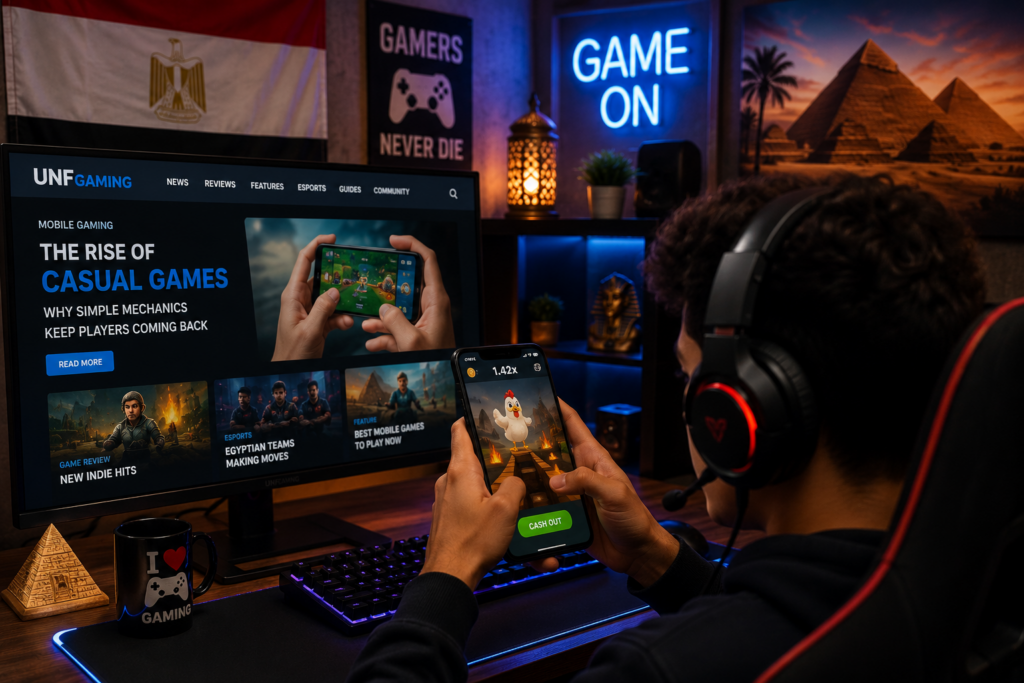
Gaming has become one of the most diverse areas of digital entertainment. At one end of the spectrum are enormous open-world releases that require dozens of hours to complete, while at the other are remarkably simple games built around a single mechanic. Both approaches can attract large audiences, but the continued popularity of lightweight reaction-based games demonstrates that complexity is not necessarily what keeps players interested.
This trend is particularly relevant in mobile-first markets, including Egypt, where smartphones provide an accessible gateway to gaming for a broad audience. Players who do not necessarily want a lengthy competitive session can instead choose games that begin almost immediately and work around short rounds. Platforms such as https://chicken-road-egypt.com/ illustrate this side of digital entertainment, combining straightforward controls with a casino-style risk mechanic in an experience adapted for Egyptian users. It is a very different proposition from traditional esports or console gaming, yet several of the design principles behind its accessibility are familiar across the gaming industry.
The Return of the One-Mechanic Game
Modern gaming often celebrates scale. New releases advertise enormous maps, hundreds of quests, advanced progression systems and increasingly detailed environments.
Yet some of the internet’s most successful casual games move in the opposite direction.
Their entire gameplay loop can sometimes be explained in one sentence. The player understands the objective almost immediately and can begin without completing a lengthy tutorial.
This simplicity is not necessarily a weakness. Designing an enjoyable experience around one mechanic can be surprisingly difficult because there are fewer systems available to hide weaknesses in the core gameplay.
A simple game needs the central action to feel satisfying.
Why Mobile Gaming Matters in Egypt
Egypt has a large, young and increasingly connected population, making mobile devices particularly important for digital entertainment.
A gaming PC or modern console requires a substantial upfront investment. Smartphones, meanwhile, are already used for communication, social media, video and everyday digital services.
Gaming becomes another function of the same device.
This accessibility encourages several types of experiences:
- browser-based games;
- casual mobile titles;
- competitive mobile games;
- puzzle and reaction games;
- lightweight online entertainment.
For developers targeting Egyptian players, efficient performance can therefore matter as much as graphical ambition.
A game that runs smoothly across a wide range of devices can potentially reach a much broader audience than one requiring premium hardware.
Mobile Gaming Changes Design Priorities
Desktop and console games can rely on keyboards, controllers and large displays. Mobile developers operate under different constraints.
A smartphone game needs to remain understandable when viewed on a relatively small screen.
|
Design element |
PC/Console |
Mobile-first gaming |
|
Controls |
Many buttons possible |
Few actions preferred |
|
Screen |
Large display |
Limited space |
|
Sessions |
Often longer |
Frequently shorter |
|
Interface |
Detailed menus possible |
Clear visual hierarchy |
|
Entry |
Dedicated gaming session |
Immediate access |
|
Hardware |
Relatively predictable |
Wide device range |
These limitations have helped popularize games where one tap can perform the main action.
Visual Feedback Is Part of Gameplay
When mechanics are simple, visual feedback becomes especially important.
Imagine a game where a player successfully avoids an obstacle but receives almost no visible response. Technically, the mechanic may function correctly, yet the interaction can feel unsatisfying.
Developers use several techniques to reinforce player actions:
- movement animations;
- screen effects;
- changing character expressions;
- score updates;
- sound cues;
- environmental reactions.
These elements communicate success or failure before the player even reads any text.
Good feedback makes an interface feel responsive.
Egypt’s Broader Gaming Community
Egyptian gaming culture extends well beyond casual browser titles.
Competitive games have developed strong communities across the country, particularly titles that can be played online with friends. Football games also have an obvious cultural advantage in a country where the sport generates enormous interest.
Gaming cafés have historically provided another important social environment, especially for players who wanted access to better hardware or multiplayer experiences.
Today, the smartphone adds another layer.
An Egyptian player might move throughout the same week between competitive multiplayer matches, football gaming, mobile titles and quick browser experiences.
Gaming identity is becoming less dependent on one platform.
What Developers Can Learn From Casual Games
Large studios and independent developers can both learn from the success of lightweight games.
Several principles translate across genres:
- Make the primary action obvious.
Players should understand what they can do without searching through menus. - Respond immediately to input.
Controls should feel connected directly to the game world. - Reduce unnecessary waiting.
Long transitions interrupt momentum. - Communicate failure clearly.
Players should understand what went wrong. - Optimize the first minute.
Many users decide extremely quickly whether they want to continue.
These lessons apply even to complex games.
Conclusion
Modern gaming culture demonstrates that an experience does not need dozens of mechanics to attract attention. Reaction games can create tension through timing, clear feedback and rapid repetition, while mobile devices make those experiences available almost anywhere.
Egypt provides a useful example of how gaming audiences are becoming increasingly mobile and diverse. Competitive titles, football games, casual entertainment and browser-based experiences can all coexist within the same player’s digital routine.
And when that mechanic crosses into casino-style entertainment involving real money, the distinction between skill and chance becomes essential. Fast interaction may make a game accessible, but responsible limits are what help keep entertainment in its proper place.