
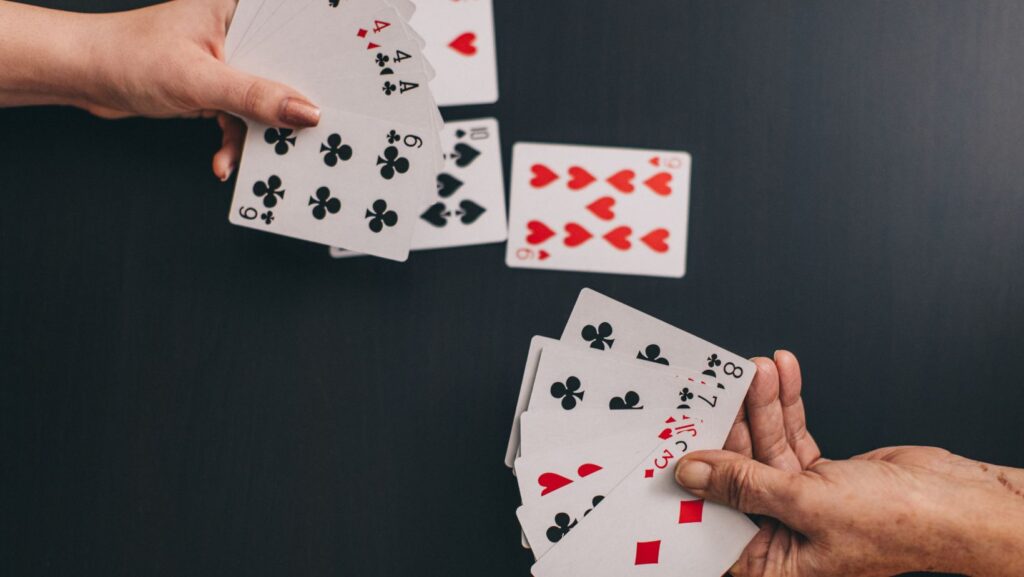
If you spend enough time in RPG taverns, spaceports, dusty outposts, or neon-lit future casinos, you start noticing a funny pattern: NPCs love their card games. It doesn’t matter if the world is full of monsters or plasma rifles or giant robots – someone, somewhere, is trying to win a hand. And that tiny detail makes fictional worlds feel social, almost cozy. It’s one thing to fight dragons, it’s another to sit across from a farmer or a smuggler and play cards for bragging rights.
Games inside games are a small design trick that tells you: people live here. Let’s look at a few famous examples that players (and NPCs) keep coming back to.
Sabacc: the best hand in the galaxy
People know of Sabacc even if they’ve never played it. It’s the reason Han Solo has a ship. It shows up in books, comics, shows, and even gets screen time in Solo: A Star Wars Story. And the rules… well, they’ve shifted almost as much as the cards do.
In the most common version, you’re aiming for a total close to 23 or negative 23. The deck has normal values, some with negatives, and a few chaotic cards that can “shift” your hand unexpectedly. It’s part poker face, part controlled chaos. You could be winning, then a random flip turns your hand into something totally new. You can see why smugglers love it.
Gwent: from minigame to real hobby
Gwent started as a little tavern distraction in The Witcher 3 and somehow turned into a full-on hobby for a lot of players. It grew into its own standalone game, with decks built around different factions rather than just “strong cards.” You draw a hand, then play your cards across two rows – melee up front, ranged behind – and each card brings more than a number. Some shift momentum, some mess with the board, and a few can flip a round you thought you’d already lost.
What makes Gwent interesting is how it scales. At first, you’re just dropping cards with big numbers. Weeks later, you’re planning combos, bluffing, reading your opponent, and bragging about your “absolutely not broken” strategy. The game feels tactical, but still relaxed enough to play in a tavern between monster hunts. In a world full of drama, it’s the perfect cooldown.
Triple Triad: pocket-sized strategy
Triple Triad in Final Fantasy VIII looks simple the moment you sit down. There’s a tiny 3×3 board, every card has a number on each edge, and if you drop a card beside your opponent’s and your number on that side is higher, you flip theirs. That’s the whole rhythm. It sounds almost too straightforward… until you start caring about which corner you use and why that one card suddenly matters more than the rest.
Five minutes later you’re rearranging your entire deck because you got outplayed by a fisherman who owns two strong cards and a weird rule set. The simplicity is the hook. The strategy sneaks up on you. Fans love it so much that the game has made appearances in later Final Fantasy titles and even got a proper digital version.
Caravan: wasteland rules apply
Caravan shows up in Fallout: New Vegas, and it looks like someone invented a card game with whatever scraps they could salvage after the bombs fell. Two players build “caravans” by laying down sequences of cards aiming for a certain score range. It’s rough, sometimes confusing, and exactly what a homemade game in the wasteland should feel like.
There’s no glossy casino energy, no polished system – it’s friends arguing about rules over bad drinks while mutants stroll outside. Caravan adds personality to a world that’s full of rust and danger, reminding you that even when society collapses, people will still argue about cards.
Pazaak: blackjack with a plot twist
If Sabacc is the big myth, Pazaak is the everyday bar game in Knights of the Old Republic. It looks like blackjack at a glance, but the strategy is in a side deck you customize before playing. That deck lets you adjust your total up or down, which makes the whole thing feel less like luck and more like a quiet duel – you brought your tools, your opponent brought theirs, and now you both pretend you know what you’re doing.
Rounds are quick, the tension is clean, and you don’t need lore knowledge to understand it. It’s the kind of game NPCs play while waiting for someone to start trouble.
Why these games stick in our heads
Every one of these games does something smart: it gives the world texture. NPCs don’t exist to wait for you – they’re living, in their own tiny loops. Seeing them play cards does more than tell a story, it lets you join their downtime.
It also blurs the line between fictional games and real ones. Plenty of developers and players use these ideas when they explore actual online card games, taking the same ingredients – deck building, bluffing, momentum, weird card effects – and turning them into something you can play outside the game world. Some of the best card titles today borrow from Gwent’s faction identity, Sabacc’s risk spike, or Triple Triad’s grid logic.
Watching NPCs shuffle cards tells you why worlds feel alive
Spend enough time in a big RPG hub and you’ll see it: someone leaning back in their chair, someone else placing a card with a smirk, the whole room humming with a story you never get told. You can ignore it and sprint to your next quest, or you can sit down and lose to a local champion who insists they “barely got lucky.”
That tiny interaction makes everything else feel bigger. Dragons, spaceships, vault doors – all great. A deck of cards? Somehow, that’s what makes a world feel human.