
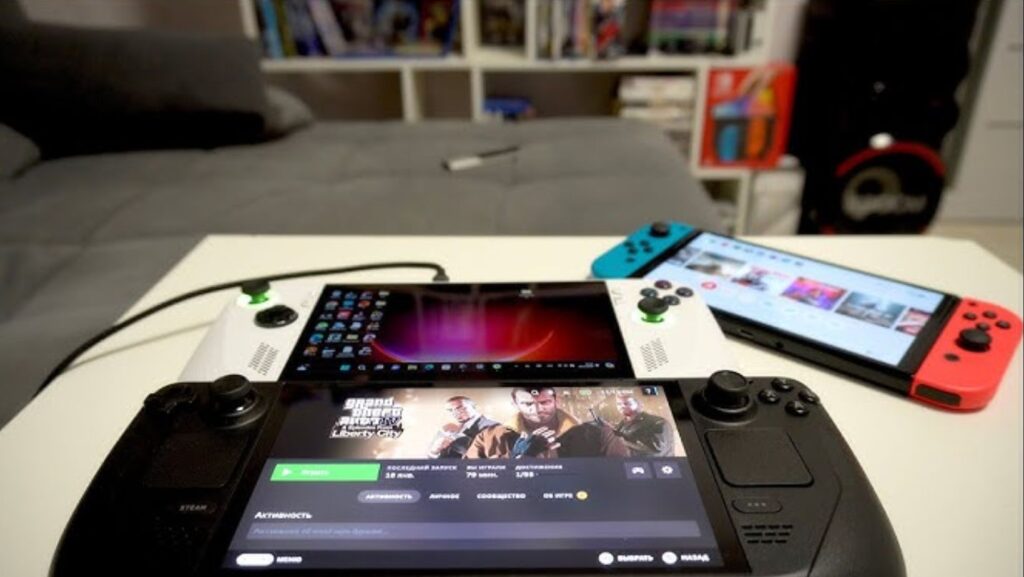
In the rapidly evolving world of portable gaming, 2026 has become the year of the handheld PC. This guide breaks down the fierce competition between Valve’s Steam Deck, the ASUS ROG Ally series, and Lenovo’s Legion Go, focusing on performance, battery life, and cost-efficiency to help you find the best device for your next journey
The Handheld Battlefield: Steam Deck vs. ASUS ROG Ally and Lenovo Legion Go
Portable gaming has transcended the era of simple mobile apps and dedicated consoles with restricted libraries. Today, the dream of carrying an entire Steam or Epic Games library in your backpack is a reality, thanks to a new generation of high-performance handhelds. These devices are essentially miniaturized computers, packing desktop-grade architecture into chassis not much larger than a traditional tablet. For the modern traveler, this means the ability to play “Cyberpunk 2077” or “Elden Ring” while cruising at thirty thousand feet or waiting for a bus.
Choosing the right device requires more than just looking at raw specs; it’s about finding a balance between power and portability. The excitement of launching a AAA title on a handheld is similar to the thrill of a high-stakes moment at https://casino-jugabets.cl/, where strategy and luck meet in a fast-paced digital environment. In the handheld market, the “win” is finding a device that doesn’t die after forty minutes of play or stutter during an intense boss fight. With prices starting to stabilize, the barrier to entry has never been lower for gamers who want premium experiences on a budget.
Valve’s Steam Deck: The Value King
The Steam Deck remains the gold standard for budget-conscious gamers, specifically due to Valve’s aggressive pricing strategy. By controlling both the hardware and the software storefront, Valve can afford to sell the device at a tighter margin, passing those savings on to the consumer. The Steam Deck OLED, released as a refined successor to the original, offers a stunning HDR display and improved thermal efficiency without the massive price hike seen in Windows-based competitors. It is the only device in this trio that feels like a true console rather than a pocket-sized PC.
What sets the Steam Deck apart is SteamOS, a Linux-based operating system designed specifically for a controller interface. Unlike Windows handhelds that often require a mouse and keyboard for troubleshooting, the Deck “just works” most of the time. This simplicity is invaluable when you are in the middle of a long road trip and don’t want to spend an hour hunting for driver updates. While it may not have the highest frame rates in the industry, its optimization ensures that games feel smooth and responsive, making it the most reliable companion for those who prioritize ease of use.
ASUS ROG Ally: Windows Power in Your Pocket
The ASUS ROG Ally, particularly the newer Ally X and Z2 Extreme variants, targets the gamer who refuses to compromise on graphical fidelity. Running on native Windows 11, the Ally offers something the Steam Deck cannot: universal compatibility with every game launcher. Whether you are a dedicated Xbox Game Pass subscriber or have a massive library on the Epic Games Store, the Ally runs these apps without the need for complex workarounds or compatibility layers. This versatility makes it a powerful tool for those who venture outside the Steam ecosystem.
ASUS has focused heavily on the “handheld feel,” creating a device that is noticeably lighter and more ergonomic than its bulky rivals. The variable refresh rate (VRR) screen is a standout feature, significantly reducing screen tearing and stuttering when frame rates fluctuate. This technology is a game-changer for playing demanding titles in a portable format, as it creates a perceived smoothness that masks lower performance. However, this power comes at a premium, and while the entry-level models are becoming more affordable, the top-tier versions still command a price close to a mid-range gaming laptop.
Lenovo Legion Go: The Big Screen Experience
Lenovo entered the fray with the Legion Go, a device that challenges the definition of “portable.” Boasting a massive 8.8-inch QHD+ display, it offers the most immersive visual experience of any mainstream handheld. For gamers who prioritize screen real estate for cinematic titles or those who also want to use their device for media consumption during flights, the Legion Go is unrivaled. Its detachable controllers, reminiscent of the Nintendo Switch but with much higher build quality, allow for a “tabletop mode” that is perfect for cramped airplane trays.
The Legion Go also includes a unique “FPS mode,” where the right controller can be placed in a magnetic dock and used like a vertical mouse. This makes it a surprisingly viable option for strategy games or shooters that traditionally require a desk setup. Despite its innovative features, the Legion Go is the heaviest of the three, which can lead to wrist fatigue during extended gaming sessions. It is a device for the enthusiast who wants a “desktop replacement” that happens to fit in a carry-on bag, rather than a discreet device for quick sessions.
Performance Benchmarks and Real-World Expectations
When comparing raw horsepower, the ASUS and Lenovo devices generally outperform the Steam Deck due to their use of the AMD Ryzen Z1 and Z2 Extreme chips. In 2026, these processors allow for 1080p gaming at medium settings in most modern titles, whereas the Steam Deck is strictly an 800p machine. This resolution difference is noticeable; the Windows handhelds produce sharper images and better text legibility. However, pushing those extra pixels requires more energy, often leading to a noisier fan and higher temperatures.
The Steam Deck counters this with incredible optimization through the Proton compatibility layer. Because developers often optimize specifically for the Deck’s hardware, many games run better on Valve’s “weaker” hardware than they do on unoptimized Windows handhelds. For example, indie gems and older AAA hits often reach a stable 60 or 90 FPS on the Deck OLED, providing a buttery-smooth experience that rivals more expensive units. If your library consists mostly of titles from three or four years ago, the performance gap between these devices becomes almost negligible in practice.
Battery Life: The Traveler’s True Metric
Battery life is the Achilles’ heel of the handheld PC market, but 2026 has seen significant improvements. The ASUS ROG Ally X led the charge with a massive 80Wh battery, effectively doubling the playtime of its predecessor. In intensive games like “Forza Horizon 5,” you can expect around three to four hours of life, which is a significant milestone for Windows handhelds. This makes the Ally X a strong contender for long-haul travel where power outlets might be unreliable or occupied.
The Steam Deck OLED remains the efficiency champion for less demanding games. Due to its lower resolution screen and optimized OS, it can push nearly eight hours of playtime in 2D indie titles or emulated retro games. The Lenovo Legion Go, while having a decent battery capacity, struggles to keep up because its giant, high-resolution screen acts as a constant drain. Travelers should always consider a 65W power bank as a mandatory accessory, regardless of which device they choose, to ensure their gaming session doesn’t end prematurely during a layover.
Software Ecosystems and User Interface
The battle between SteamOS and Windows 11 is a matter of philosophy versus functionality. SteamOS provides a streamlined, “console-like” experience where you can suspend and resume games instantly with a single button press. This “sleep mode” is perhaps the most important feature for a portable device, allowing you to stop playing the moment your plane lands and resume exactly where you left off when you reach the hotel. It feels cohesive, polished, and entirely focused on gaming.
Windows 11, used by ASUS and Lenovo, offers the freedom of a full PC but carries the “Windows tax” of background updates and clunky navigation. While ASUS’s Armoury Crate and Lenovo’s Legion Space attempt to hide the desktop behind a controller-friendly overlay, you will inevitably find yourself squinting at tiny icons or fighting with a virtual keyboard. The benefit, however, is that you are not restricted by Linux compatibility. If you play competitive games with intrusive anti-cheat software, like “Destiny 2” or “Call of Duty,” a Windows-based handheld is your only viable option.
Ergonomics and Portability in the Field
Portability is about more than just dimensions; it’s about how the device feels in your hands after two hours of play. The Steam Deck is often praised for its “sculpted” grips and trackpads, which provide unparalleled control for mouse-driven games. Its layout is wide, which helps distribute the weight, making it feel lighter than it actually is. The ASUS ROG Ally, on the other hand, is the most compact of the trio, fitting more easily into standard messenger bags and even some large jacket pockets.
The Lenovo Legion Go is a beast that demands its own dedicated case. While its build quality is premium, its sharp edges and significant weight make it less ideal for “holding” in the traditional sense; it is best used with the kickstand on a flat surface. For a person traveling light with only a backpack, the ASUS ROG Ally or the Steam Deck are the clear winners. If you are a digital nomad who carries a large tech bag and wants the most versatile workstation/gaming hybrid, the Legion Go’s bulk becomes a justifiable trade-off.
Pricing and Long-Term Value
Value is where the Steam Deck continues to dominate the conversation. With refurbished units and lower-tier LCD models frequently going on sale, it is possible to enter the world of handheld PC gaming for under four hundred dollars. Even the premium OLED model is priced aggressively compared to the starting MSRP of its rivals. Valve treats the hardware as a gateway to their store, whereas ASUS and Lenovo are traditional hardware manufacturers who need to make a profit on every unit sold.
However, the “hidden costs” of the Windows handhelds are lower if you already have a large library on other platforms. If you have years of free games from Epic or a long-running Game Pass subscription, you won’t need to buy a single game to get started on an Ally or Legion Go. On the Steam Deck, you are primarily encouraged to stay within the Steam ecosystem, and while you can install other launchers, it requires a level of tinkering that might be daunting for casual users. In the long run, the “best deal” depends entirely on where your digital library currently resides.
Conclusion
Ultimately, the choice between the Steam Deck, the ASUS ROG Ally, and the Lenovo Legion Go depends on your specific needs as a traveler and a gamer. If you want the most affordable, reliable, and user-friendly experience, the Steam Deck OLED is the undisputed champion. It offers the best battery life for indie titles and the most polished software, making it perfect for those who just want to play without the headache of managing a Windows PC. It is the sensible choice for most people who value their time and money equally.
If you require the highest possible performance and want access to every game launcher under the sun, the ASUS ROG Ally series is the way to go. Its lightweight design and superior screen technology provide a premium feel that justifies its higher price tag for the hardcore enthusiast. Meanwhile, the Lenovo Legion Go remains the niche choice for those who crave a massive screen and the versatility of detachable controllers. No matter which you choose, the era of compromising on your gaming experience while on the move is officially over, as these portable powerhouses bring the full magic of PC gaming to the palm of your hand.