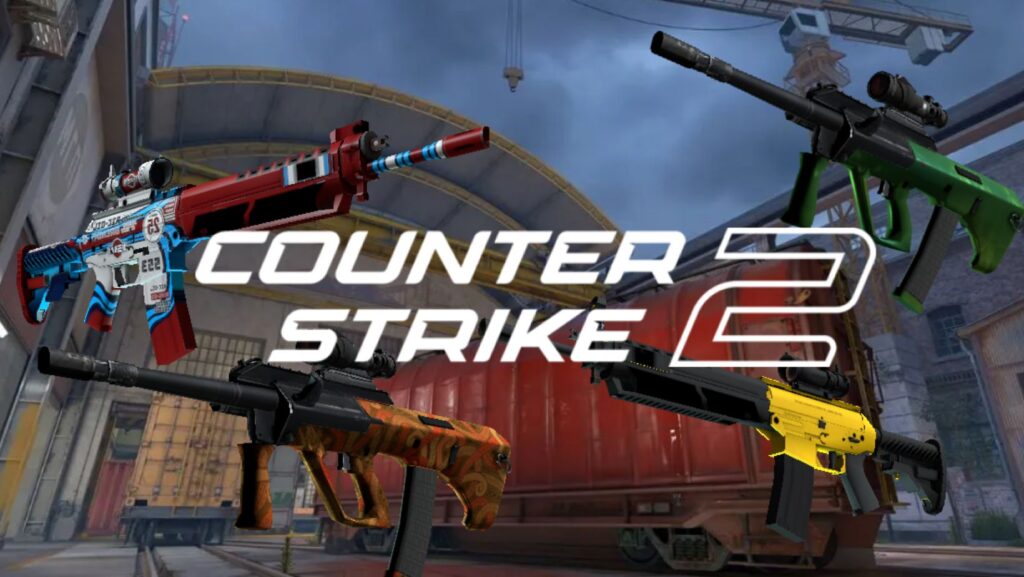
The Counter-Strike 2 market has evolved from a simple video game marketplace into a $4 billion financial infrastructure. While traditional investors view gaming with skepticism, digital pixel enthusiasts have seen their inventories significantly outperform the most stable stock indices. This evolution mirrors high-end entertainment sectors where liquidity and strategy are paramount, much like the experiences found on platforms such as https://jugabet-chile-casino.cl/, where risk management defines the winner. In this landscape, a skin is no longer just a texture; it is a value-backed contract supported by a global community. The transition from CS:GO to CS2 in 2023 did more than just upgrade graphics; it revalued assets that now behave like digital “blue chips,” attracting institutional capital and private collectors looking to diversify their portfolios far beyond conventional banking systems.
The Analogy: S&P 500 vs. the CS2 Inventory
To understand the scale of this phenomenon, we must look at the data. The S&P 500, the gold standard of the stock market, has historically offered an average annual return of 10%. In contrast, legendary CS2 items like the AWP Dragon Lore have gone from costing $300 to exceeding $15,000 in a decade—a growth of over 4,000%. This disparity turns the skin market into an economic anomaly where the compound interest of rare items shatters conservative financial projections. While a stock represents a share in a company subject to regulations and quarterly reports, a skin is a liquid asset whose scarcity is absolute and auditable on Valve’s internal blockchain. In 2026, investors no longer ask if skins are a bubble; they ask how to balance their exposure to this market against government bonds.
Katowice 2014 Stickers: The Diamonds of the Web
If there is one asset that represents the peak of gaming profitability, it is the Katowice 2014 holographic stickers. These cosmetics, which originally cost less than a dollar, have reached astronomical valuations exceeding $80,000 per unit, as seen with the legendary Titan Holo. The secret to this growth is not just nostalgia, but the “burn” mechanic: once a sticker is applied to a weapon, it disappears from the inventory as an independent item, permanently reducing the global supply. In a stock market, companies can issue more shares, but in CS2, no one can manufacture more 2014 stickers. This forced deflation creates constant upward pressure. Owning one of these stickers today is the digital equivalent of owning an original Action Comics #1; it is a piece of technological history whose value lies in its impossibility of replication.
Collector Psychology and Status Symbols
The skin market operates under luxury laws similar to those of Rolex or Ferrari. A Karambit Case Hardened knife with a “Blue Gem” pattern is not sold for its utility in the game, but for the status it grants the owner. In the digital economy of 2026, identity is built through rare pixels. This psychological demand ensures that, even during global economic corrections, high-end assets maintain their price. Chinese collectors, who now dominate much of the market, treat skins as a store of value, moving millions of dollars in private transactions that often bypass the official Steam market to avoid price caps. This behavior validates the thesis that skins have transcended gaming to become a social currency with real purchasing power, capable of being liquidated into fiat currency in minutes.
Programmed Scarcity and the End of “Drops”
Unlike traditional assets where production can adjust to demand, the CS2 ecosystem utilizes cases and collections that Valve periodically retires. When a case stops dropping after matches, it becomes a finite resource. Investors who accumulated thousands of “Operation Breakout” cases years ago for a few cents now control assets that have multiplied by 200. This programmed scarcity is the engine that allows mid-range skins to outperform Silicon Valley tech companies. The finitude of digital objects creates an investment environment where time is the holder’s best ally. In 2026, the strategy of “buying and forgetting” discontinued cases is seen by many young investors as a more viable and exciting alternative than opening a standard retirement savings account.
Liquidity and Secondary Markets in 2026
One of the biggest hurdles to considering skins as a real investment was the difficulty of withdrawing money. However, the maturation of secondary markets like Buff, CSFloat, and Skinport has solved this liquidity problem. Today, selling a $10,000 knife is almost as fast as selling a share of Apple on a brokerage platform.
These markets operate with competitive commissions and allow direct withdrawals to bank accounts or cryptocurrencies, closing the financial circle. Liquidity is the lubricant that keeps this $4 billion market spinning. Furthermore, the rise of automated arbitrage systems and trading bots in 2026 has professionalized price discovery, reducing bid-ask spreads and making the entry point for new investors much less risky than it was in the early days of the skin economy.
Risk Factors: The Shadow of Valve
Not everything is a guaranteed profit in the world of pixels; platform risk is the skin investor’s greatest enemy. Valve Corporation holds total control over the global inventory, and a unilateral decision—such as a change in trading rules or the introduction of a new item acquisition system—could crash prices overnight. This is known as “regulatory risk” in the traditional world, with the difference that there is no central bank or government to appeal to. History has shown moments of panic, such as the introduction of the seven-day trade lock, which caused a temporary drop in liquidity. However, Valve has proven to be a prudent administrator of its own economy, understanding that investor confidence is what keeps interest in the game alive and, consequently, their commission revenue stream flowing.
The Impact of the Asian Market on Valuations
The massive influx of capital from China has been the catalyst that pushed the prices of rare stickers and skins into the stratosphere. Asian investors do not see CS2 just as an esport, but as a platform for prestige and savings. The creation of “collector clubs” on social platforms has generated fierce competition for items with the lowest wear (float) or the most unusual patterns. This phenomenon has injected unprecedented liquidity into the high-end market, raising the prices of “Souvenir” items and legendary sticker combinations to levels the Western market would likely never have reached alone. In 2026, the Beijing time zone dictates the price trends for Butterfly Knives, and understanding this dynamic is fundamental for any investor aspiring to outperform the S&P 500.
Diversification: From Knives to Sticker Containers
A smart investment portfolio in CS2 does not bet everything on a single luxury skin. Diversification is achieved by spreading capital across different asset classes: closed cases, recent tournament stickers, and “meta” weapon skins (like the AK-47 or M4A1-S). While high-end knives offer stability and status, Major tournament sticker capsules offer the potential for explosive growth at a low cost. For example, investing in capsules during the final sale of a tournament has proven to be one of the most consistent strategies, with returns often tripling the initial investment in less than 24 months. This market segmentation allows investors to adjust their risk profile, using common skins as “cash” for quick trades and rare items as long-term growth assets.
Conclusion: The Future of Ludic Investment
The CS2 skin economy has proven that value does not reside solely in the tangible, but in scarcity, cultural demand, and utility within a vibrant ecosystem. By outperforming the S&P 500 in terms of gross return, Counter-Strike has validated the concept of “ludic investment,” where product knowledge and community passion translate into real financial gains. Although risks intrinsic to the digital nature of the asset remain, the market’s maturity in 2026 suggests that we are looking at a permanent asset class. Investing in an iBUYPOWER Holo sticker today might seem like madness to a traditional banker, but for a new generation of investors, it is simply the most efficient way to put capital to work on the frontier of the digital economy. The pixel market is here to stay, and its story is only beginning to be written on the screens of millions.