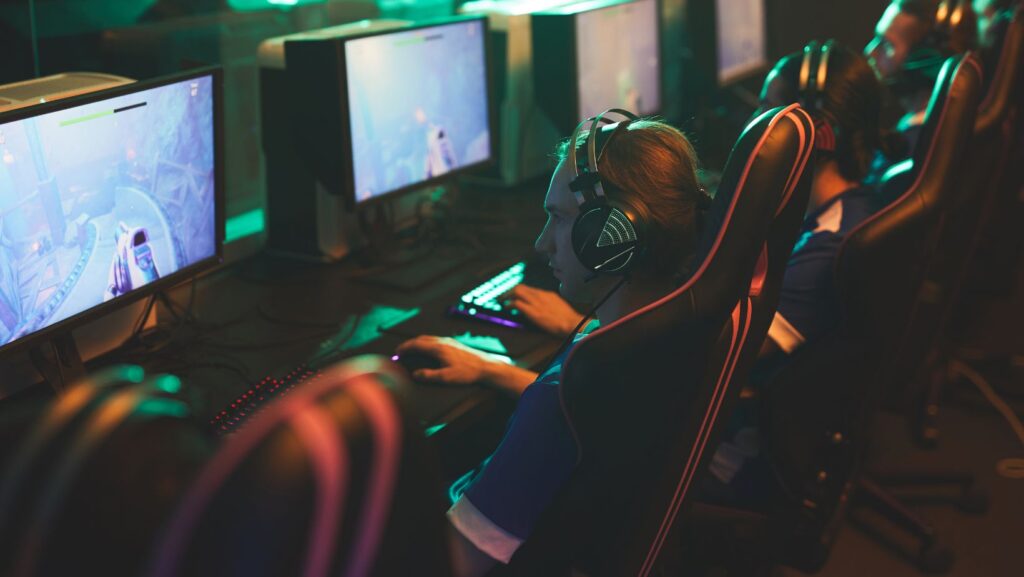
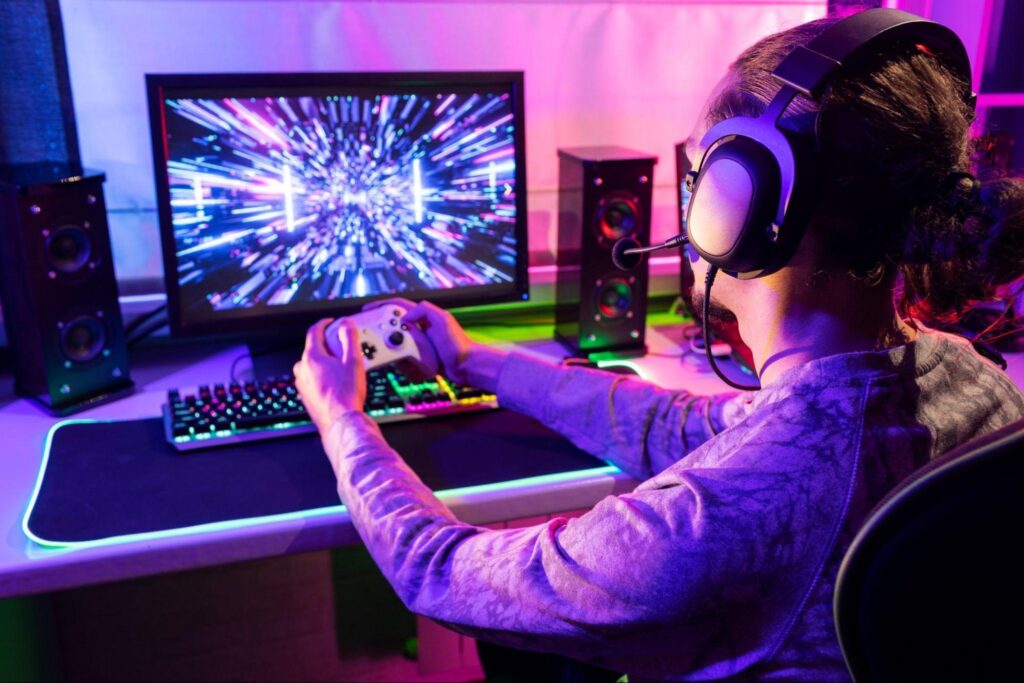
Games talk to players, constantly, even when no actual words are being used. Every sound, animation, and visual signal exists to explain what’s just happened to the player, what is currently going on, and what’s about to come next.
Without these cues, even the best-designed game would feel super confusing and unresponsive. Overall, it would be a disappointing and frustrating experience for the player.
But why do we need feedback-driven design in games? Simply speaking, it’s what makes games meaningful, and once you start noticing it, you will see the same design language structure everywhere, operating on clear scientific principles.
What Feedback-Driven Design Means
At its core, feedback-driven design is about response. Every input gets a reaction, whether it’s front and centre, or a little more subtle. The clearest example: you press a button, and the game shows (visual) and plays (sound) responses without delay.
This signals to the player that each action is tied to the outcome, the system is functioning just as it should, and there’s no lag getting in the way of gameplay.
This isn’t just conjecture, it’s science. Studies show that both visual and sound effects create that immersion that makes players feel like they’re really there. For example, a recent study exploring sound in video games found that even small changes in how effects and music are implemented can completely alter the experience for the player.
Timing, the type of sound, the ramping up of volume, background soundtrack, they all contribute, with the cited study showing that engagement is 30-40% higher in games featuring immersive audio elements. The same concepts apply to the visuals, too.
Feedback Across Different Game Types
To really understand what these concepts mean, let’s move away from theoretical explanations and go into actual examples from real games:
RPGs and Strategy: Signalling Abilities and Character Progression
RPG and strategy games are slower in the experience, not in-your-face action that constantly hits you with dopamine. Here, visual and sound feedback is crucial, as you don’t get as many chances to keep immersive gameplay going.
For abilities, it’s not about the moment they’re used; that’s easy. No, the cooldown is arguably more important. That’s more subtle, and more difficult to get right. You need a ‘timer’, showing when that ability will be usable again, a noise that signals depletion, or weakness. When your powers return, there needs to be a feeling of fullness/rejuvenation for the player.
For character progression, it’s a layered and incremental experience. When the player reaches a new level, the UI needs to provide a visual overview of the increased abilities. The game motifs show escalation, progression, and a movement towards the goal.
Imagine a spell that’s cast, with a glowing circle around the player’s character. There’s a brief swell in the music, and a cooldown arc appearing on the skill button. Players not only experience the excitement of the cast spell, but instantly know that there has been a depletion in the character’s available powers.
Casino and Live Games: Rhythmic Signals for Clarity
For casino games, like slots or table games, the design language is all about trust, communicating to the player that their actions are happening live, that the game’s response is instant, and that results are 100% legit.
Because online casino games are replicating a physical experience, designers need to bring players as close as possible to the experience of Las Vegas or Atlantic City. Reels, card flips, and table chips need to follow predictable motion patterns, mimicking what you’d experience in a live casino, because they’re the alternative option for players.
SkyCity, the leading iGaming platform in NZ, has strong physical casino competition in the country, so the company knows exactly how important it is for players to feel like they’re there, fine-tuning visual and sound responses to deliver a near-identical experience.
Consider their live dealer games, for instance. These use real people in a studio, hosting table games like roulette and blackjack. The feeds are live, and they need to stay immersive; no lagging, no pixelation, a 1:1 game, whether in person or at home.
It’s not just about the gameplay itself, either, with dealers having to interact with players, giving the same banter back and forth you’re used to at the table. Now, just imagine what VR will be able to do for live table games.
Action and Shooters: Immediate Impact and Physicality
Action games and shooters give players what feels like a physical response. The designer’s goal is to create the feeling that reactions are quick, an undeniable confirmation of the player’s action. Getting this exactly right is why a game series like Call of Duty still leads the best-seller list every single year.
For example, when a player hits an enemy during gameplay, you get a distinct ping or thud, removing doubt that the shot has landed. For gamers, the use of controllers, like the PS5, for example, provides a rumble, a tactile cue, generating a real-life physical response.
The key to effective feedback lies in strong, immediate loops that demand attention, supported by subtler, softer touches working quietly in the background. The player needs to feel like they’re right in the middle of the action, not watching from above.
Games Need to ‘Talk Back’
Great games are interactive; it’s a give-and-take. They will flash, hum, pulse, and pause at exactly the right moments. For all of this to work, sound designers, artists, and developers need to work together to deliver a perfectly synced experience.
To the gamer, it’s a given that this is what games feel like. Yet what happens under the hood is incredibly complex and essential to smooth gameplay. Without sound and visual feedback, the game would, quite simply, be a flop.